Moving to West Palm Beach, FL means trading a state income tax bill for a housing market where the median home runs past $400,000, and there’s no ocean beach inside the city limits. The Atlantic sits 5 minutes east, across the Intracoastal in the separate town of Palm Beach. This guide covers what housing actually costs, which neighborhoods suit which budgets, who’s hiring, how the county schools work and the two things newcomers underestimate: August humidity and the annual hurricane routine.
The Local Geography a New Resident Learns First
West Palm Beach is a mainland city of 117,415 people at the 2020 Census and the county seat of Palm Beach County, and picking an address here comes down to how far west you’re willing to live. VISIT FLORIDA describes the city as sitting directly across the Intracoastal Waterway from the island of Palm Beach, which is a separate town with its own police, its own parking rules and almost none of the housing stock a new resident can realistically buy.
Three housing bands cover most of what a newcomer will tour, and they price very differently. The first is the downtown core within about a mile of the water, which is high-rise apartments and condos. The second is the ring of 1920s historic districts just south of downtown, where the houses are small, the trees are old and the price per square foot is highest. The third is everything west of I-95 toward Royal Palm Beach and Wellington, which is where the square footage is, along with the newer construction and the two-car garages.
Your daily orientation is set by four roads rather than by landmarks. I-95 and Florida’s Turnpike carry you north and south, Okeechobee Boulevard runs east from the western suburbs straight into downtown, and Southern Boulevard does the same a few miles south. Most residents drive to work, so plan on owning a car unless you’re committing to downtown.
What It Costs to Live in West Palm Beach
Housing is where the local premium shows up. The median property value was $414,200 against a median household income of $73,446 in 2024, per Data USA’s West Palm Beach profile of American Community Survey figures, and Zumper puts the median one-bedroom rent at about $1,650 a month as of September 2026. Those numbers set the tone for everything else, because housing is the line item that moves most when people compare this city with the one they’re leaving.
Florida charges no state income tax, which is the single most cited reason people relocate here and does real work against housing costs for higher earners. It does less for hourly workers, who feel the rent more than the tax savings.
Budget separately for insurance. Windstorm and flood coverage are normal line items in South Florida rather than optional extras, and they’re the expense that surprises people arriving from states where homeowners insurance is a rounding error. Run your own numbers before you sign anything, and if you’re pricing the move itself, our moving cost calculator gives you a starting estimate.
Neighborhoods and Who Each One Suits
Downtown: High-Rise Apartments and a Walk-to-Work Commute
Downtown West Palm Beach is the one part of the city where you can genuinely skip the car. Clematis Street is the historic commercial spine, a block from the water, and it carries the bars, the restaurants and the live music rooms. CityPlace, the open-air retail and dining district on South Rosemary Avenue, sits a few blocks inland and holds Eataly and RH. Downtown is loud and late on weekends and quiet on Monday nights, so audition the noise before you sign a lease on a low floor.
Flamingo Park: 1920s Bungalows and the City’s Best Small-Business Strip
Flamingo Park sits just south of downtown and holds Mediterranean and mission-style bungalows on tree-lined streets. Over the past few years it’s become the city’s most active small-business district, with bakeries, Pilates studios and chef-driven counters filling the storefronts along South Dixie Highway. Supply is limited and houses move quickly, so buyers here tend to wait for the right one rather than shop a wide list. It suits people who want a historic house and a walkable coffee run more than they want a garage.
Grandview Heights: Historic Streets Beside Howard Park
Grandview Heights is a small historic district next to the Palm Beach County Convention Center, mixing Mediterranean Revival houses with more modern infill. Howard Park sits at its edge, and CityPlace and the Convention Center are both walkable. The trade is scale: this is a compact district with no commercial strip of its own, so you’re borrowing downtown’s amenities rather than having your own. It works well for people who want to be near the action without living on top of the nightlife.
El Cid: Waterfront Addresses and Dock Access
El Cid is the Mediterranean Revival district running down to the Intracoastal south of downtown, and it’s almost entirely residential. Streets are shaded, houses are large and many have been renovated or rebuilt, which is why this is one of the most expensive addresses on the mainland. The draw for a lot of buyers is the water itself and the boating that comes with it. If the boat arrives before the dock does, boat storage is a common stopgap while a slip or a lift gets sorted out.
Northwood Village and Northwood Hills: The Value Play North of Downtown
Northwood sits about 10 minutes north of downtown and is where the walkable-but-affordable math still works. Northwood Village is a compact district of galleries, antiques dealers, vintage clothing and small independent kitchens. Rents in the Northwood Hills area run below the downtown and waterfront neighborhoods, and the area is in the middle of a development wave, which means both rising values and construction noise depending on the block. West of downtown, the 700-acre Northwest Historic District is the historic heart of the city’s African American community.
SoSo: A Yard, a Bike Route and a Short Drive Downtown
SoSo, short for South of Southern, is the quiet stretch south of Southern Boulevard toward the water. It’s bike-friendly, the restaurants are neighborhood places rather than destinations, and the housing runs to single-family homes with yards. Families and remote workers land here when they want space without a 30-minute drive to dinner. It isn’t walkable in the downtown sense, so plan on a car for groceries.
The Warehouse District and the NORA District: The Newest Blocks
Two adaptive-reuse districts have changed where younger residents spend their time. The Warehouse District, between Caroline and Blanche Streets, trades as Caroline Station and WPB Exchange, holding a surf shop, vintage sellers, a yoga studio and an all-day Australian cafe. The NORA District along North Railroad Avenue came in at about 154,000 square feet in its first phase, with bagels, ice cream, a juice bar and a motorcycle-and-coffee concept open. Neither is residential yet in any real volume, but both change the calculation on living downtown.
Palm Beach Island and the Western Suburbs: The Two Extremes
Palm Beach island is where the ocean, Worth Avenue, The Breakers and the Flagler Museum are, and it isn’t where most people who work here live. Parking is metered and enforced hard, some restaurants carry dress codes, and the housing is priced accordingly. At the other end, the western communities past the Turnpike deliver newer houses, more bedrooms and gated golf communities such as The Club at Ibis, at the cost of a longer drive east. Most newcomers end up choosing between those two poles rather than at either one.
Jobs, Employers and the Commute South
Healthcare, tourism and finance carry the local job market. Good Samaritan Medical Center and St. Mary’s Medical Center are the large healthcare employers, and hospitality runs on the record 9.5 million visitors Palm Beach County drew in 2023, as WFLX reported. Finance firms have been moving in too, and mortgage servicer Onity Group, formerly Ocwen Financial, is headquartered in the city.
Remote workers are a real share of recent arrivals, and the absence of a state income tax is usually the reason. If your employer is in Fort Lauderdale or Miami, the Brightline station downtown makes that commute survivable in a way I-95 doesn’t.
Schools and Higher Education in Palm Beach County
The School District of Palm Beach County is the 10th-largest district in the U.S., with 22,801 employees and a 96.7% graduation rate, according to the district’s own figures. Because the district covers the whole county rather than the city, your school assignment follows your address closely, and two houses a mile apart can feed different schools. Check the assignment before you make an offer, not after.
Magnet and choice programs are a bigger part of the picture here than in most districts. Bak Middle School of the Arts and Suncoast High School are the names local parents raise first, and both draw students from well outside their immediate areas. For higher education, Palm Beach Atlantic University sits downtown near the waterfront and gives that stretch of the city a college-town feel that surprises people.
Getting Around Without Fighting I-95
Most residents drive, but downtown has more options than the rest of the city. The free downtown trolley stopped running in 2023. Instead, the Circuit on-demand shuttle runs 7 a.m. to 9 p.m. daily for an average fare of about $2, and the city’s $1 West Palm Move fixed route along Dixie Highway is launching this fall, per Hoodline. Palm Tran buses cover the county, and Tri-Rail handles the longer commuter runs south.
Brightline is the piece that changes the math. The West Palm Beach station at 260 Quadrille Plaza Drive puts Boca Raton, Fort Lauderdale, Aventura and Miami within an easy ride, and service also reaches Orlando, so a weekend without a car is realistic. Palm Beach International Airport is the home airport and sits about 10 minutes from downtown, with Fort Lauderdale-Hollywood International as the backup when fares are better. Miami is roughly 70 miles south, about an hour and a half by car on a good day.
The Two Seasons, Hurricane Season and What Newcomers Underestimate
West Palm Beach runs on two seasons rather than four, and the calendar reshapes daily life. High season runs November through April, peaking January to March: snowbirds arrive, restaurant reservations get hard, traffic thickens and the city feels twice as busy. May through October empties out, which is when residents get their favorite tables back. January highs average about 75°F with lows near 58°F, while July and August run about 90°F and 76°F, per the NOAA normals for West Palm Beach.
Summer is wet as well as hot. August is the rainiest month at 8.68 inches, followed by June at 8.48 and September at 7.96, and the near-daily afternoon thunderstorm is short but dependable. Plan outdoor errands for the morning between June and September. The flip side is the sunshine count, which the city’s own visitor bureau puts at over 230 days a year.
Hurricane season runs June 1 through November 30 and peaks around September 10, with most activity between mid-August and mid-October, according to the National Hurricane Center. Residents treat it as a yearly routine rather than a crisis: newer buildings use impact-resistant windows and concrete block walls, and preparing a home each spring is normal. Humidity is the quieter problem. Paper, wood furniture, fabric and anything with an adhesive suffer in a hot garage, which is why climate-controlled storage in West Palm Beach is the default rather than the upgrade for anything you plan to keep.
The other adjustment is what a smaller Florida home actually holds. Buyers arriving from the Northeast or the Midwest routinely downsize by a bedroom or a basement, and a 10×10 storage unit, about half a one-car garage, absorbs a one-bedroom apartment’s worth of overflow while you figure out what stays. If you’re only holding the contents of one room, a 5×10 unit is usually enough, and our storage unit size calculator will get you closer than guessing.
Settling In: Where Locals Eat, Shop and Spend Weekends
Grato is the restaurant most new arrivals get pointed to first. Clay Conley’s casual sibling to Buccan does wood-fired pizza and pasta on South Dixie Highway, serves dinner daily from 5 p.m. with a bar happy hour from 5 to 6 p.m., and runs a Sunday brunch from 11 a.m. to 3 p.m., per Grato’s site. Parking on this stretch of South Dixie Highway is free, and it’s far easier to get into than the island restaurants. Half-price bottles on Wine Mondays are how a lot of people meet their new neighbors.
Okeechobee Steakhouse is the institution. Founded in 1947 at 2854 Okeechobee Boulevard, west of downtown, it bills itself as Florida’s oldest steakhouse, is run by the same family three generations on, and pours from a list of more than 800 wines. Hand-cut, dry-aged prime steaks are the point, and its Okeechobee Prime Meat Market sells the beef if you’d rather cook at home.
Cholo Soy Cocina is the cheap one worth knowing. The Latin American counter at 3715 South Dixie Highway, near Antique Row, turns out ceviche and tacos for lunch and dinner daily. The dining room is tiny, so expect a wait or plan to take it away. It’s the answer when you’ve spent the day unpacking and nobody wants to cook.
The West Palm Beach GreenMarket is the weekend anchor for most residents. The Saturday farmers market returns on October 3, 2026, running 8:30 a.m. to 1:30 p.m. on the Great Lawn at 100 North Clematis Street every Saturday into late May, and USA Today readers have voted it the No. 1 farmers market three years running. It’s free, dogs on short leashes are welcome, and three city garages park free during market hours. Go early, because the good produce disappears by midmorning.
Antique Row is where a new house gets furnished. More than 30 antique, design and gallery storefronts run along South Dixie Highway between 2700 and 3900, per the district’s own directory, carrying vintage furniture, art and lighting. Plan a weekday or a Saturday and give it a full day rather than an hour. It’s also the classic reason people rent storage here, because the sideboard you find on a Tuesday rarely fits the room you have on Wednesday.
For the outdoors, Grassy Waters Preserve is the local surprise: 23 square miles, about 15,000 acres, of remnant Everglades wetland inside the city limits, with a cypress boardwalk and some of the best birding in the county. It doubles as the city’s drinking water supply, so canoe trips are staff-guided only and worth booking. Once you’ve settled in, our guides to the best restaurants in West Palm Beach, weekend brunch around the city, neighborhood shopping districts and things to do in West Palm Beach go deeper than this one can, and the seasonal calendar guide explains why April and May are the months to invite family down.
Frequently Asked Questions
Is it worth moving to West Palm Beach?
It’s worth it if the no-income-tax math and year-round outdoor weather outweigh housing costs that run past a $414,200 median property value. The city has a real downtown, a growing finance and healthcare job base, and Brightline service to Miami and Orlando. It’s a harder sell if you need a low housing cost, a strong bus network or a summer you can spend outdoors all day.
Is West Palm Beach expensive?
Yes, mainly through housing and insurance. The median property value is $414,200 and the median one-bedroom rent runs about $1,650, while the median household income is $73,446. Windstorm and flood insurance add a line item most newcomers have never budgeted for. Florida’s lack of a state income tax offsets part of the cost, especially for higher earners.
What salary do you need to live comfortably in West Palm Beach?
Using the common guideline of spending no more than 30% of gross income on housing, a median one-bedroom rent of about $1,650 a month implies roughly $66,000 a year for one household to rent comfortably. Buying at the $414,200 median property value takes considerably more. Two incomes make the math far easier here.
Is it better to live in Miami or West Palm Beach?
They solve different problems. Miami is roughly 70 miles south and offers a far bigger job market, deeper international connections and a much denser city. West Palm Beach gives you a smaller and quieter downtown and easier access to the water without Miami’s traffic or prices. Brightline runs between the two, so plenty of people live here and work there.
What’s the difference between West Palm Beach and Palm Beach?
West Palm Beach is the mainland city of 117,415 residents and the county seat. Palm Beach is a separate, much smaller town on the barrier island across the Intracoastal Waterway, reached in about 5 minutes over the Royal Park or Flagler Memorial bridges. The island holds Worth Avenue, The Breakers and the ocean beaches. Nearly all of the region’s housing, jobs and daily errands are on the mainland side.
Storage While You Settle In
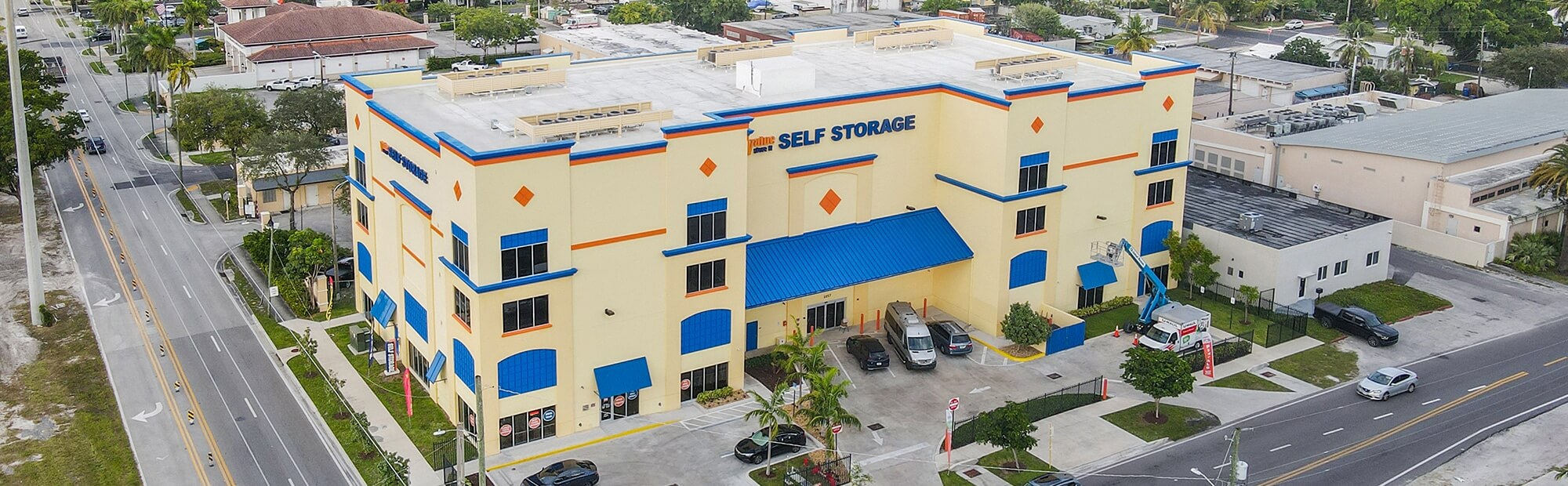
Most moves here land in one of two situations: the new place is smaller than the last one, or it isn’t ready on the day the truck is. Our West Palm Beach storage facility rents month-to-month with no long-term contract, which is what makes a slipped closing date a scheduling problem instead of an expensive one. At the small end, a 5×5 locker, about the size of a small closet, takes boxes, files and seasonal gear, and a 10×5 unit handles a furnished bedroom. Larger households usually land on a 10×15 unit for a two-bedroom apartment or a 10×20 unit for a three-bedroom home, with a 10×30 unit for a four-bedroom home. Because so much of life here happens on the water and on the road, there’s also RV parking and car storage for the vehicle the new driveway won’t take. If you’re still deciding where in the city to land, we can hold your things while you do.