Moving to Miami Lakes, FL gets you a planned town of about 30,500 people built around 23 lakes and a walkable Main Street, about 15 miles northwest of downtown Miami and about 13 miles from Miami International Airport. Housing is the number that decides everything else: Livability’s Miami Lakes profile puts the median home value near $524,532 and median rent near $1,660. Schools grade well, and the honest trade is a quiet, car-dependent town. Below are the costs, the neighborhoods, the job market, the weather and the first-month checklist.
Miami Lakes in the Northwest Miami-Dade Map
Miami Lakes is a real incorporated town, not a Miami neighborhood, and a small one. It covers 6.51 square miles, of which 5.66 is land, and it incorporated on December 6, 2000, with a 2020 Census population of 30,467, according to Wikipedia’s Miami Lakes entry. Hialeah wraps around it to the south and west, Miami Gardens sits to the east, and Country Club is to the north. The ZIP codes you’ll see on listings are 33014, 33016 and 33018.
The Palmetto Expressway runs straight through the middle and splits the town into two halves that feel different. East of the Palmetto is the original 1962 development, begun by what’s now The Graham Companies on land owned by state senator Ernest "Cap" Graham and master-planned by Lester Collins with curving, tree-shaded roads and lakes instead of the square grid used everywhere else in the county. The west side is newer, wider and closer to the Turnpike.
That plan is the reason the town reads the way it does. What you get in practice is a town center you can walk, a lot of grass and a short list of things you have to leave town for, starting with an enclosed mall and a beach.
What It Actually Costs to Live in Miami Lakes
Expect to pay a Miami-Dade price for a suburban house. Livability puts the median home value at $524,532, median monthly rent at $1,660, median household income at $92,309 and median property tax at $3,371. Niche reads the same town higher, at a $626,400 median home value, $2,120 median rent and $101,557 median household income, and grades cost of living a C plus with housing at C minus.
Both readings are worth knowing, because the gap between them is roughly the gap between the older east-side housing stock and the newer west-side product. About 60% of residents own their homes and 40% rent, per Niche. Rentals are the tighter market of the two: single-family houses dominate the town, and the apartment inventory clusters along the commercial edges rather than inside the residential loops.
The cost people underestimate is the overlap. Florida closings slip, and a family selling in one county while buying in another often ends up with a gap of a few weeks between the two dates. A 10×10 storage unit in Miami Lakes holds the contents of a one-bedroom apartment, which is the size a lot of households need when the calendar doesn’t cooperate.
Where to Live in Miami Lakes
Original Miami Lakes: The Lakefront Streets East of the Palmetto
Original Miami Lakes is the 1962 Lester Collins plan and the reason people move here specifically rather than to northwest Miami-Dade generally. Streets curve, the tree canopy is mature, and lakefront lots back onto the water in Loch Lomond and around Lake Katharine. Tot lots and small parks are sprinkled through the loops, so errands and playground runs stay short. It’s the highest price point in town and the stock is older, which means you should budget for roofs, impact windows and air-conditioning systems that are due.
Royal Oaks and the West Side in 33018
West of the Palmetto Expressway, toward NW 87th Avenue, the town was built out later and looks it. Roads are wider, houses are newer, and Royal Oaks Park, home to the Roberto Alonso Community Center, anchors the area with four athletic fields, open play areas and a tot lot. Turnpike access is easier from this side, which matters if you commute to Broward. The trade is a longer drive to Main Street and less shade.
Satori: The Newest Gated Community
Satori is Lennar’s gated community of 482 homes, 226 townhomes and 256 single-family houses on 128 acres, with a clubhouse, gym, pool, splash pad and walking park, according to the Miami Laker’s Satori profile. This is where buyers land when they want new construction and impact glass already installed rather than a renovation project.
The Main Street District
The Main Street district is the only part of Miami Lakes where you can live without driving to dinner. Roughly 228,000 square feet of mixed-use space (Graham Commercial) holds brick sidewalks, striped awnings, more than two dozen restaurants, boutiques, a 13-screen cinema, the Main Street Players theater company and a Saturday farmers market. There are over 1,600 free spaces on the street and behind the shops plus a 300-space garage, and every space is complimentary, which in Miami-Dade is genuinely unusual. Homes in the district are limited, and it’s the loudest corner of an otherwise quiet town on Friday and Saturday nights.
The Miami Lakes Drive Corridor by the Palmetto
The commercial corridor where Miami Lakes Drive meets the Palmetto isn’t somewhere you buy a house, but it’s where a lot of people land first. Royal Oaks Plaza, the town’s largest shopping center at 55 storefronts anchored by Winn-Dixie, sits here, and Candlewood Suites is about a mile west of Main Street with kitchens in the rooms. Renting an apartment or an extended-stay suite while you look at houses is the standard play, and a 5×5 locker is usually enough for the boxes and seasonal gear that won’t fit in a temporary room.
The Job Market, the Commute and Getting Around
Miami Lakes has a real employment base for a town its size. BankUnited is headquartered here, as are The Graham Companies and Potamkin Auto Group, and the office parks built into the original master plan are still occupied. Niche grades the local job market a B minus.
Plenty of residents commute out instead, and the geography is the selling point. The Palmetto Expressway and the Turnpike both touch the town, Miami International Airport is about 13 miles away, Fort Lauderdale-Hollywood International is roughly 22 miles, and downtown Miami is about 15 miles southeast. Metrobus serves the town, and the Town of Miami Lakes runs Freebee, a free, on-demand, fully electric ride service that operates every day and links Town Hall and Veterans Park to the Palmetto Metrorail station on weekday mornings and afternoons.
Small business owners moving a company here run into the same wall as everywhere in Miami-Dade, which is that warehouse space starts far larger and far more expensive than a five-person operation needs. Renting 10×30 units for inventory, samples and seasonal stock is how a lot of local businesses bridge the gap between a garage and a lease.
Schools Serving Miami Lakes
Miami-Dade County Public Schools serves Miami Lakes, and the schools are the single strongest thing in the town’s report card. Niche grades public schools an A and ranks Miami Lakes 77th of 382 Florida suburbs for public schools. High school students are typically zoned for Barbara Goleman Senior High School or Hialeah-Miami Lakes Senior High School.
The magnet option is the one families move for. Miami Lakes Educational Center, known locally as Miami Lakes Tech, runs grades 9 through 12 through career academies covering Cambridge, health, entrepreneurship, communications, information technology and trades, and it shares its campus with an adult technical college. Graduates can leave with both a high school diploma and a vocational certificate.
Private options exist too. Our Lady of the Lakes Catholic School has served the town since 1986 and enrolls roughly 580 students from pre-K through eighth grade, with about 16 students per teacher in federal data. Adult education levels track the school quality: 27% of residents hold a bachelor’s degree and 17% hold a master’s or higher, per Niche.
Parks, Golf and What Weekends Look Like
The parks system is unusually deep for 5.66 square miles of land. The Town of Miami Lakes runs Miami Lakes Optimist Park with four baseball fields, a softball field, two soccer fields, two flag football fields, basketball and tennis courts and batting cages, plus Veterans Park with a lighted walking path, Royal Oaks Park, Picnic Park East with The Spot youth center, the K-9 Cove dog park, six passive lakefront parks and 41 tot lots.
Golf is inside the town limits, which is rare in this part of the county. Miami Lakes Golf Club on Miami Lakes Drive is an 18-hole, par-72 semi-private course originally designed by Bill Watts in 1962 and completely redesigned by architect Bruce Hepner, with a driving range, a pro shop and The Deck as its 19th hole. It reopened to the public in November 2025 and is home to the First Tee of Miami.
Weekends default to Main Street. The Main Street Players stage a full theater season plus a children’s camp and Comedy at MSP, the cinema handles August afternoons, and the town’s own events calendar carries Sabor Fest along Main Street on October 10, 2026. For the eating end of it, the best restaurants in Miami Lakes and the town’s brunch rooms cover the Main Street lineup in detail, and the Miami Lakes shopping guide covers where to buy furniture once the house is yours. Youth league families learn quickly that cleats, bats, bikes and paddleboards outgrow a Florida garage with no basement, and a 5×10 unit absorbs a season’s worth of gear.
Weather, Hurricane Season and the Flooding Question
Miami Lakes uses the Miami International Airport climate normals: an average high of 84°F, a low of 71°F and 67.41 inches of rain a year, per NOAA’s 1991 to 2020 normals. The calendar has two seasons rather than four. The National Weather Service in Miami puts the wet season at roughly mid-May to mid-October, and the dry season runs from late October through April, with January averaging 76°F highs and 61°F lows. Summer rain arrives as a heavy late-afternoon thunderstorm rather than all-day drizzle, which is why locals run errands in the morning.
Hurricane season runs June 1 through November 30, peaking around September 10, with most activity between mid-August and mid-October. Say it plainly: this is South Florida, and a named storm will eventually close schools and offices for a day or two. New residents should sort out shutters or impact glass, a generator plan and flood coverage during the dry season rather than in August.
Street flooding is the more common everyday issue, and it’s a fair question to ask before you buy. Miami Lakes sits at about 7 feet of elevation, 0.85 of its 6.51 square miles is water, and drainage is an active town capital project, with the Loch Lomond Phase II drainage improvements out to bid. Ask about a specific street’s history rather than the town’s average. Humidity is the quieter problem: paper, photographs, wood furniture, electronics and anything upholstered don’t survive a garage without air-conditioning here, which is why climate-controlled storage in Miami Lakes is the default rather than the upgrade. If you want the month-by-month version, the best time to visit Miami Lakes guide breaks the year down.
Your First 30 Days in Miami Lakes
Set up utilities first. Electricity comes from Florida Power & Light, natural gas from Peoples Gas where it’s available, and water and sewer from Miami-Dade Water and Sewer, all of which want the service address and a connection date plus a deposit for new accounts. Internet and cable are worth confirming before closing, so you aren’t waiting on an installation window after the truck leaves.
Then handle the paperwork with deadlines attached. Florida requires a state driver license within 30 days of establishing residency, and vehicles must be titled and registered within 10 days, according to FLHSMV’s new resident page. Voter registration goes through the Miami-Dade County Elections Department. Miami-Dade garbage collection runs two days a week for most homes, and bulky waste pickups are scheduled with the county, which is the detail that decides how you dispose of moving boxes and the furniture that didn’t make the cut. Our moving checklist sequences the rest.
Finally, do the fun part deliberately. Walk Main Street on a weeknight, pick up a Saturday farmers market habit, and work through the things to do in Miami Lakes list over the first few months. A town of 30,000 rewards showing up.
Storage While You Settle In
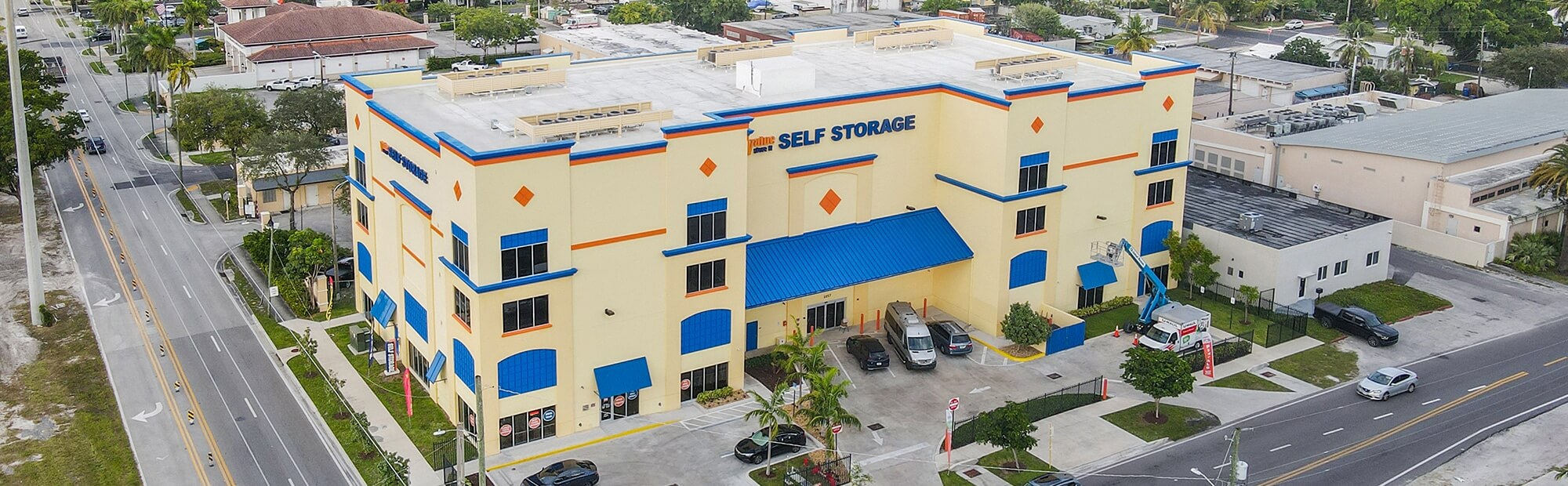
Value Store It sits in Miami Lakes with month-to-month rentals and no long-term contract, which is the right structure when you don’t yet know whether you need space for six weeks or a year. A 10×5 holds the contents of one room, like a furnished bedroom, and a 5×15 takes a studio apartment’s worth. Step up to a 10×15 and you’re holding a two-bedroom apartment with appliances, while a 10×20 holds a three-bedroom home between closings. Every full-size unit at the facility is climate-controlled, and our unit size guide will get you closer than guessing from a floor plan.
Frequently Asked Questions
Is Miami Lakes a good place to live?
Miami Lakes grades A minus overall on Niche, with an A for public schools, an A for families, a B for crime and safety and a C plus for cost of living. The trade is that it’s quiet and car-dependent, with nightlife limited to Main Street and its immediate surroundings.
Is Miami Lakes prone to flooding?
Street flooding after heavy rain is a real issue in parts of Miami Lakes. The town sits at roughly 7 feet of elevation, 0.85 of its 6.51 square miles is water, and it’s actively spending on drainage, with the Loch Lomond Phase II project out to bid. Ask about the specific street and check the flood zone before you sign anything.
Is Miami Lakes expensive to live in?
Miami Lakes is expensive by national standards and mid-range by Miami-Dade standards. Median home value readings range from $524,532 (Livability) to $626,400 (Niche), with median rent between $1,660 and $2,120 depending on the source. Median household income runs $92,309 to $101,557, so local pay tracks local prices better than in coastal Miami neighborhoods.
Is Miami Lakes the same as Hialeah?
No. Miami Lakes is a separate incorporated town with its own council-manager government, incorporated on December 6, 2000, while Hialeah is a much larger neighboring city. Hialeah borders Miami Lakes on the south and west, and the two share ZIP code edges and a lot of daily traffic, but they have different governments and different tax bills.
Is Miami Lakes a city?
Miami Lakes is a town, which in Florida is a municipality like any other. It runs a council-manager government with a mayor and six council members, contracts law enforcement from the Miami-Dade Sheriff’s Office, and is served by two Miami-Dade Fire Rescue stations. Its motto is "Growing Beautifully," and its town hall sits on Main Street.
Making the Move
Miami Lakes suits people who want Miami-Dade access without Miami density: strong public schools, 23 lakes, a Main Street you can walk to and an airport about 13 miles away. Come see it on a weekday afternoon and again on a Saturday morning before you commit, because the town reads very differently at those two hours. When the boxes outnumber the rooms, Value Store It in Miami Lakes can hold the overflow until the house catches up.