Moving to Hollywood, FL puts you in a city of about 153,000 people, Broward County’s third-largest at the 2020 census, between Fort Lauderdale and Miami, where your address is priced almost entirely by how close it sits to the Atlantic. East Hollywood costs the most and walks the best. West Hollywood buys square footage and a garage. Almost every other decision, from your commute to your insurance bill, follows from where you land on that line. This guide covers what living here costs, which neighborhood suits which household and the parts of the first year that listings don’t mention.
Hollywood’s Layout, Priced From the Ocean Inward
Hollywood reads as four north-south spines, and price falls with every one you move west. Ocean Drive and A1A run the barrier strip. Federal Highway (US-1) sits about a mile inland and carries the older commercial stock. I-95 splits the city through the middle, and State Road 7 and Florida’s Turnpike mark the western edge. Rent drops as you go west, and car dependence climbs at the same rate.
The commute math is the other half of the map. Hollywood sits about 20 miles north of Miami, roughly a 30-minute drive on I-95 depending on traffic. Fort Lauderdale is about 10 miles north, and Fort Lauderdale-Hollywood International Airport sits just past the city’s northern edge. The city also has its own rail stops: Tri-Rail serves Hollywood station at 3001 Hollywood Boulevard, which it shares with Amtrak, and a second station at Sheridan Street.
One local service is worth knowing before you assume you need two cars. The Sun Shuttle, an all-electric on-demand service booked through the Circuit app, runs in two zones, East (downtown, east Hollywood and the beach) and West. Rides cost $2 per rider, and you can also flag one down on the street, though app requests take priority and you ride whatever route the driver is already taking. The city’s free Holly-Go shuttle runs fixed routes that connect to Broward County Transit, so the downtown-to-sand trip doesn’t have to disappear into beach parking.
Where to Live in Hollywood, Neighborhood by Neighborhood
Hollywood Lakes and East Hollywood: The Walkable Pick
Hollywood Lakes and East Hollywood hold the older homes on curving streets laid out around Joseph Young’s man-made lakes, between downtown and the sand. It’s the most walkable residential pocket in the city, which is why locals tend to name East Hollywood first when someone asks where to buy. It’s also the priciest place to rent inland, and the west side costs less and asks more of your car. The trade is older housing stock, less square footage per dollar and closets built to midcentury expectations, which is where a 5×5 storage locker, about the size of a small closet, quietly solves the seasonal overflow.
Hollywood Beach: Living on the Broadwalk
Hollywood Beach is the strip east of the Intracoastal, built around a brick promenade of nearly 2.5 miles running from Jefferson Street north to Sheridan Street. The Broadwalk is closed to cars, lined with cafes and bars, and Travel + Leisure named it one of America’s best beach boardwalks (City of Hollywood). Living here means the ocean is your front yard and the visitors are your neighbors.
Parking is the daily reality of a beach address. The Garfield, Nevada Street and Margaritaville garages plus on-street meters carry the load, and they fill on winter weekends when the season peaks. The city’s plastic and foam ban also covers single-use plastic and polystyrene food-service items on city property, including the beach, the parks and ArtsPark, so a few beach-day habits change when you move here.
Downtown Hollywood: Dinner Without the Car
Downtown Hollywood is six blocks of Hollywood Boulevard and Harrison Street ringing ArtsPark at Young Circle, and the district sits on the National Register of Historic Places. It carries the densest run of bars, galleries and restaurants in the city, including the Downtown Hollywood Mural Project and the Art and Culture Center of Hollywood, which took over Cinema Paradiso Hollywood in 2025. The Downtown Hollywood ArtWalk lands on the third Saturday of every month, 6 to 10 p.m., with a free guided mural tour at 6.
Thanks to Harrison at 2001 Harrison Street shows where downtown is heading. Chef Ivan Proseniuk runs an all-day kitchen open 8:30 a.m. to 10 p.m. Sunday through Thursday and until 11 p.m. on Friday and Saturday, with syrnyky at breakfast and whole baked branzino at dinner, and weekend brunch is worth booking a few days ahead. Street parking is metered, and the room is dog-friendly.
Downtown’s appeal cuts both ways for residents. Mickey Byrne’s Irish Pub at 1921 Hollywood Boulevard runs until 2 a.m. Sunday through Thursday and 4 a.m. on Friday and Saturday. If you want to walk home from dinner, this is your neighborhood; if you want silence at 1 a.m., look a few blocks off the boulevard.
Emerald Hills: Golf Course Quiet North of Sheridan
Emerald Hills is the quieter, family-oriented pocket north of Sheridan Street, laid out around The Club at Emerald Hills. The club is semi-private, but it takes public tee times you can book online, so living nearby doesn’t require a membership to play. Buyers here get space and calm, and accept that dinner and the beach both involve a drive.
Hollywood Hills and the Johnson Street Corridor: The Best Value in the City
Hollywood Hills is strip-mall Hollywood west of downtown, and it’s where a lot of the city’s food actually lives. Salvadoran, Guatemalan and Italian-American kitchens sit close together on Johnson Street, State Road 7 and Hollywood Boulevard, and very little of the food costs much. It isn’t scenic. It’s consistently some of the best value in Hollywood, both to rent in and to eat in.
Pupusatime shows how the neighborhood grows. The Salvadoran pupusa counter outgrew its original Johnson Street room and moved a few blocks to a bigger space, now at 1114 N State Road 7 with about 53 seats and on-site parking. Mimi’s Ravioli at 5714 Johnson Street solves the other half of the food problem: a family-owned Italian-American grocery with its own pasta factory next door, selling mozzarella made fresh every day plus frozen house pastas, ciabatta and cannoli. For a wider run through the city’s kitchens, our guide to the best restaurants in Hollywood covers this corridor in detail.
Everyday shopping on this side of town anchors at Hollywood Hills Plaza, 3251 Hollywood Boulevard, where the Target runs 8 a.m. to 11 p.m. It’s the first stop the week you move in, not a browsing destination.
West Hollywood and Boulevard Heights: Square Footage and a Garage
West Hollywood and Boulevard Heights run toward the Turnpike and State Road 7 with newer builds, more space per dollar and no realistic way to live without a car. Movers priced out of the beach side land here for the garage and the extra bedroom. The bealls store at 6651 Taft Street handles clothing, shoes and home goods and stays open until 9 p.m. most nights. If you’re buying out here and renovating before you move in, a 10×20 storage unit holds the furniture from a three-bedroom home while the floors go down.
What Living in Hollywood Actually Costs
Florida has no state income tax, which is the number every relocation pitch leads with. The honest counterweight is insurance, the expense that most often surprises newcomers, and a coastal Broward address is exactly where it shows up. Get real quotes on specific properties rather than a metro average, because the figure moves with the roof, the year built and the distance to water. Rent follows the same east-to-west gradient as the map: the closer to the Intracoastal, the more you pay for less space. Our moving cost calculator handles the one-time side of the math.
Closing dates rarely line up cleanly here, which is the cost nobody plans for. When a sale closes before the purchase, or a lease ends three weeks early, the gap gets solved with a short-term unit rather than a hotel and a loaded truck in a driveway. A 10×10 unit takes a one-bedroom apartment’s worth of furniture, which covers most of those gaps.
The Job Market and the Daily Commute
Hollywood’s own economy leans on the beach, the Seminole Hard Rock, retail corridors and health care, and plenty of residents work in Fort Lauderdale or Miami and sleep here. That regional job market sits 10 to 30 minutes away in either direction, depending on which end of the city you live in and what I-95 is doing that morning.
Commuting is better served than the region’s reputation suggests. I-95 runs the length of the city, Tri-Rail stops at Hollywood and Sheridan Street for anyone avoiding the drive, and Broward County Transit covers the local grid. The airport and Port Everglades both sit a short drive from the north end of town, which suits anyone whose work involves travel.
The Seminole Hard Rock at 1 Seminole Way, on the Seminole Tribe’s Hollywood Reservation off State Road 7, is the biggest single destination on the west side. The 450-foot Guitar Hotel opened in October 2019 and runs a free nightly light and music show. It carries a Hollywood address, and it’s the landmark most people picture when you tell them where you moved.
Schools and Where Families Land
Broward County Public Schools serves Hollywood, alongside charter and private options. Check current school assignments with the district for any specific address, since boundaries move.
Emerald Hills and the west side draw most families for space and a driveway. The everyday payoff sits inland at T.Y. Park, 3300 N Park Road, where the Castaway Island water playground pairs a swimming lagoon and wading pools with slides and interactive water features. It’s seasonal, open spring through late September, with all-day entry at $10 per person, and the park gate adds $3 per vehicle carrying eight or fewer people on weekends and County holidays, with nothing to pay on a weekday, so check the season calendar before you promise the kids.
Hurricane Season, Humidity and Your First Florida Year
Hurricane season runs June 1 to November 30, with peak activity from mid-August to mid-October, and residents treat preparation as a calendar item rather than a hypothetical. Hollywood’s history is direct on this point: the September 18, 1926 hurricane killed 37 people in the city, tore roofs off buildings and stalled the growth Joseph Young had just started. Most seasons mean a watched forecast and a few disrupted days, but the insurance and the supply list come with the address.
The rest of the year is the reason people come. NOAA’s 1991 to 2020 normals for Fort Lauderdale-Hollywood International Airport put January, the coolest month, at an average high of 76°F and low of 61°F, and July and August at 90°F and 78°F. June is the wettest month at about 9.6 inches, February and March are the driest at about 2.4 inches each, and the rainy season runs roughly June through October, mostly as short afternoon showers. If you’re timing a house-hunting trip, our guide to the best time to visit Hollywood breaks the year down month by month.
Humidity is the quiet variable in a move. Paper, wood furniture, upholstery and anything with electronics don’t enjoy a south Florida garage in August, and plenty of newcomers learn that with a box of photographs. Climate-controlled storage in Hollywood is the straightforward answer for whatever won’t fit inside the air conditioning during that first year.
Errands, Weekends and What Genuinely Needs a Car
The practical dividing line in Hollywood is I-95. East of it, downtown to the beach works on foot, by bike or on the Sun Shuttle, and plenty of households get by with a single car. West of it, everything is a drive and a second car stops being optional. Decide which version of the city you want before you choose a neighborhood, because the two cost different amounts in ways rent alone won’t show you.
Yellow Green Farmers Market at 3080 Sheridan Street is the weekend anchor and the best argument for the inland side of town. Hundreds of food, produce and craft stalls fill the site on Saturdays and Sundays, 10 a.m. to 6:30 p.m. year-round. Parking runs $8 in the north lot and $15 in the south lot and is free after 5 p.m., and the traffic getting in can be brutal, so go early or use the rideshare zone.
Anne Kolb Nature Center at 751 Sheridan Street covers the other kind of weekend. It sits inside West Lake Park, a roughly 1,500-acre mangrove estuary, with a five-level, 68-foot observation tower, boardwalks over the mangroves, an exhibit hall with a 3,500-gallon aquarium, and kayak rentals. It’s minutes from the beach and feels like another county.
For bigger shopping trips, the honest answer is that the best options sit just outside the city: Dania Pointe about 10 minutes north in Dania Beach, Aventura Mall 15 to 20 minutes south and indoors, which matters in August, and Sawgrass Mills in Sunrise 25 to 30 minutes northwest. Our Hollywood shopping guide covers what’s worth the drive.
A few local rhythms are worth learning early. Yellow Green only opens on weekends. Le Tub on the Intracoastal doesn’t take reservations, so the deck seats carry a real wait at peak hours. Weekend brunch downtown books days ahead rather than hours, which our Hollywood brunch guide gets into. And Florida stone crab season only runs October 15 to May 1, which is the sort of thing you learn once by ordering claws in July.
Frequently Asked Questions
Cost of moving to Hollywood, FL: what should I budget?
Budget for three things beyond the movers. The first is rent or a mortgage priced by proximity to the water, with the east side costing more than the west. The second is homeowners and flood insurance, the expense newcomers most often underestimate, so get property-specific quotes before you commit. The third is a gap between closing dates, which a short-term storage unit usually covers.
What are the pros and cons of moving to Hollywood, FL?
The pros are a car-free beach promenade of nearly 2.5 miles, a walkable historic downtown, no state income tax, two Tri-Rail stations and a deep, affordable food scene along Johnson Street and State Road 7. The cons are insurance costs on a coastal address, summer humidity, hurricane season and beach parking that fills every winter weekend. It’s a working city with a beach, not a resort town.
Is Hollywood Beach safe?
Hollywood Beach is a public promenade with steady foot traffic, regular city events and the police presence that comes with a tourist district, and most residents treat it as they would any busy urban beachfront. Safety varies block by block across a city this size, so check current neighborhood-level data with the City of Hollywood and walk a prospective street at night before signing.
Does Hollywood, FL have a downtown?
Yes. Downtown Hollywood covers about six blocks of Hollywood Boulevard and Harrison Street around ArtsPark at Young Circle, and the district is listed on the National Register of Historic Places. It holds boutiques, galleries, the Downtown Hollywood Mural Project, the Art and Culture Center of Hollywood, Cinema Paradiso Hollywood and the densest run of bars and restaurants in the city, all walkable.
Which is nicer, Hollywood Beach or Fort Lauderdale beach?
They’re built for different lives. Hollywood Beach is lower-rise and family-leaning, with a brick Broadwalk closed to cars and older motels alongside newer resorts. Fort Lauderdale’s beachfront is taller, busier and more nightlife-driven, about 10 miles north. For daily living with kids or a dog, Hollywood usually wins. For a bigger night out, people drive north.
What’s Hollywood, FL weather like year-round?
Warm. NOAA normals put January, the coolest month, at about 76°F by day and 61°F at night, while July and August average highs of 90°F. The rainy season runs roughly June through October with frequent short afternoon showers, and June is the wettest month at about 9.6 inches. February and March are the driest. Hurricane season spans June 1 to November 30.
Storage While You Settle Into Hollywood
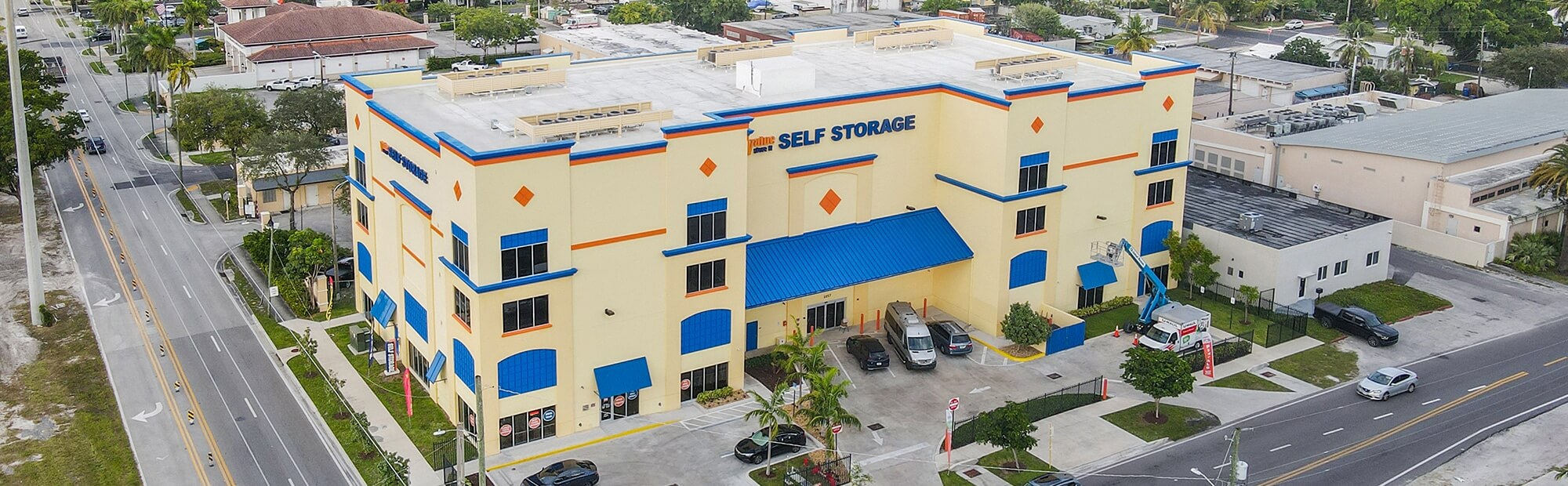
Most moves here need space for a few weeks or a few months, and Value Store It’s Hollywood location rents month-to-month with no long-term contract, so the unit ends when the move does. If you’re staging a house or waiting on a closing, 5×10 units hold the contents of one room, about a furnished bedroom, and the 10×5 layout is the same 50 square feet turned the other way, which suits long pieces better. Households downsizing from a house to a beach condo usually need more, and 10×15 spaces take a two-bedroom apartment without a fight. At the top end, 10×30 storage holds the contents of a four-bedroom home, which covers most renovations. If you’re not sure which you need, the storage unit size calculator sizes it in about a minute, and the team in Hollywood will walk you through the options when you’re ready.