Moving to Miami, FL works best when you pick the neighborhood first and the address second, because this is a metro of separate small cities rather than one downtown with suburbs around it. Brickell and downtown suit people who want to walk to work, Coconut Grove and Coral Gables suit families, the beach suits anyone willing to trade parking for sand, and south Miami-Dade buys you a yard. This guide covers what it costs, where to live, the job market, schools, the climate and how to get around.
Orientation: How Greater Miami Actually Fits Together
Greater Miami reads north to south along the water and east to west by causeway. Biscayne Bay splits the mainland neighborhoods of Brickell, downtown, Wynwood, Little Havana, Coconut Grove and Coral Gables from the barrier island of Miami Beach, and the Everglades close off the western edge of the county.
The City of Miami itself is small. It held 442,241 people at the 2020 Census on about 36 square miles of land, according to U.S. Census Bureau QuickFacts, inside a metro of more than 6 million. Much of what people call Miami is a different municipality with its own taxes and permitting: South Beach and Lincoln Road are in the City of Miami Beach, the Biltmore and Miracle Mile are in Coral Gables, and Dolphin Mall is in the city of Sweetwater. Your rent, your commute and your tax bill all depend on which line you land inside.
Traffic fills in the rest of the map. Brickell, Wynwood, Little Havana and the Design District sit close to downtown. South Beach, Coconut Grove, Coral Gables and Miami International Airport depend heavily on the causeways and the hour, and Aventura, Doral, Hialeah and Pinecrest are a real commute at rush hour.
What Living in Miami Actually Costs
Florida charges no state personal income tax, which is the biggest financial reason people move here and the one that shows up in every paycheck. That advantage gets partly eaten by housing, insurance and car costs, so the honest way to budget is to treat the tax saving as the thing that makes the rent survivable rather than as free money.
Property taxes come with a real offset if you buy. Florida’s homestead exemption reduces the taxable value of a permanent residence by up to $50,000 and qualifies the home for the Save Our Homes assessment limitation, which caps how fast your assessed value can climb (Florida Department of Revenue). File for it in the county where you buy, and budget separately for windstorm and flood coverage, which are often quoted apart from standard homeowners insurance.
Square footage is the quiet cost. Much of the inventory in Brickell, downtown and Miami Beach is studio and one-bedroom stock in towers, with closets sized for a wardrobe rather than a household. People arriving from a house often put the contents of a one-bedroom apartment into a 10×10 unit in Miami for the first year, and our storage unit size calculator answers the size question faster than guessing at a floor plan.
Where to Live in Miami: Neighborhoods and Who They Suit
Brickell and Downtown Miami: Towers, Transit and No Car Required
Brickell is the dense financial district and the closest thing Miami has to a place you can live without driving: glass towers, gyms downstairs, Brickell City Centre for shopping and a dine-in cinema, and the free Metromover looping into downtown. Rents run high for the square footage, and the trade is walking to work and to dinner.
Downtown is the value version of the same idea, with the museum cluster on the bay. Pérez Art Museum Miami is free on Thursdays after 5 p.m., stays open until 9 that night, and is closed Tuesday and Wednesday (PAMM). The Frost Museum of Science next door is open daily, with hours that vary by day and season (Frost Science), so check before you go.
Coconut Grove: Shade, Sailing and a Walkable Village
Coconut Grove is where people land when they want a slower Miami without leaving the city: banyan-shaded streets, sailing marinas, CocoWalk and a village center you can walk, with housing running from older bungalows to new mid-rise. The tree canopy is what makes summer bearable here.
Chug’s Diner, a Michelin Bib Gourmand, sets the tone for daily life in the Grove with a cast-iron pancake and a La Completa plate on a patio that’s unusable in a summer squall and perfect the rest of the year. Barracuda Taphouse pours craft beer at pink picnic tables on Fuller Street, which tells you most of what you need to know about a night out down here.
Coral Gables: The Planned City for Relocating Families
Coral Gables is a Mediterranean Revival city with mature trees and Miracle Mile as its main street, and it’s the standard answer for families relocating with school-age kids. The Venetian Pool and Fairchild Tropical Botanic Garden are close, and the Biltmore Hotel anchors the place. It opened January 15, 1926, celebrates its centennial this year, is a National Historic Landmark and has a Donald Ross golf course that dates to 1925 (The Biltmore).
Everyday Gables is quieter than its reputation. Madruga Bakery mills its own flour on a stone mill and turns it into egg sandwiches and guava and cheese danishes, and Tinta y Café, another Michelin Bib Gourmand, is a neighborhood sandwich counter. Weekend late mornings are the worst time to walk into either.
Miami Beach: Beach Living and the Parking Tax
Miami Beach is a separate city on a barrier island, and living there means committing to the parking problem. The city runs 66 surface lots, 12 garages and 19 residential permit zones, with payment through ParkMobile or PayByPhone (City of Miami Beach). Get the residential permit for your zone in your first week.
South Beach is loud, walkable and Art Deco, with sand across the street from most of it. Mid-Beach and North Beach, farther up the island, are the quieter version, with the Beachwalk path along much of the shoreline. Macchialina, at 820 Alton Road, is the tell that people actually live down here: a small neighborhood Italian room, not a scene restaurant.
Wynwood, Little River and the Upper East Side: Where the New Restaurants Open
Wynwood is a former warehouse district turned mural district, low-rise, best on foot and the obvious pick for people in their 20s and 30s. Wynwood Walls is the ticketed 62,000-square-foot outdoor museum showing more than 130 artists, open daily 10:30 a.m. to 6:30 p.m., and the surrounding neighborhood murals are free to walk.
Little River, Little Haiti and the MiMo strip along Biscayne Boulevard are where the openings have moved. Bar Bucce takes no reservations, so residents time the 4 to 6:30 p.m. happy hour instead of waiting, and ZeyZey in Little Haiti, open Tuesday through Sunday, books ticketed shows with food from Tacos María. If eating out is a big part of why you’re moving, our Miami restaurant guide goes deeper by neighborhood.
Little Havana: The Most Specific Sense of Place in the City
Little Havana runs along Calle Ocho, and it’s the neighborhood that gives newcomers the fastest sense of belonging somewhere particular. Ventanitas sell cafecito to the sidewalk, domino players hold court at Máximo Gómez Park, and the housing stock is older, smaller and often cheaper than the towers to the east.
Sanguich de Miami, a Bib Gourmand at 2057 SW 8th Street, builds its Cubano on house-made meats, which makes it a lunch plan rather than a dinner one. Ball & Chain runs live salsa in a pineapple-shaped bandshell out back and is busiest on Viernes Culturales, the last Friday of each month. Early evening is when you can actually dance.
Doral and Airport West: Newer Construction and Real Parking
Doral is business parks, newer housing and the practical choice for people whose work sits near Miami International Airport or who want a garage without a long commute. Dolphin Mall, just over the line in Sweetwater, and CityPlace Doral cover the shopping, and Tripping Animals Brewing Co. runs a warehouse taproom with hazy IPAs, a full kitchen and, unusually for Miami, free parking on site.
Pinecrest, Cutler Bay and South Miami-Dade: Space, Yards and Weekend Farms
South Miami-Dade is where the square footage lives. Pinecrest, Palmetto Bay and Cutler Bay trade commute time for lot size, and families here get Pinecrest Gardens, Zoo Miami across about 750 acres with 4 miles of walkways, and The Falls in neighboring Kendall for everyday shopping. Weekends pull farther south to the Redland and the Homestead fruit stands. The commute north to Brickell is the price, and it’s worst in the morning rush.
Jobs, Business and the Bilingual Advantage
Miami’s economy runs on international trade, tourism, real estate, healthcare and a finance and tech sector that has grown fast, and the common thread is that business here gets done across borders. Spanish is a working language, not a bonus skill, and in sales, healthcare, hospitality and legal work it moves you up the shortlist quickly.
Small business is unusually visible here, from single-location restaurants to import operations working out of Doral and Hialeah warehouses. That’s also why so many local companies keep inventory and seasonal stock in climate-controlled storage in Miami rather than paying commercial rent for space they need part of the year.
Schools, Universities and Family Logistics
Miami-Dade County Public Schools runs the public system for the entire county, so your school assignment follows your address rather than your city, and magnet programs draw from across the district. Families relocating midyear should settle the assignment and magnet questions before signing a lease, because boundaries aren’t obvious from a map.
Higher education is spread across the metro, with Florida International University, the University of Miami in Coral Gables and Miami Dade College downtown. FIU also runs The Wolfsonian-FIU and the Jewish Museum of Florida-FIU in South Beach.
Climate, Humidity and Hurricane Season
Miami has two seasons, not four. The dry season runs roughly November through April, with highs from the mid-70s to the mid-80s, lower humidity and less rain. The wet season runs May through October, with highs from the mid-80s to about 91°F and near-daily afternoon thundershowers that usually pass quickly. The city takes about 67 inches of rain a year, based on the NOAA 1991 to 2020 climate normals at Miami International Airport. Schedule outdoor plans for the morning from May onward and you’ll rarely get soaked.
Hurricane season runs June 1 through November 30, peaks around September 10, and concentrates its strongest activity between mid-August and mid-October (NOAA National Hurricane Center). An average season produces 14 named storms, seven hurricanes and three major hurricanes. Living here means a shutter or impact-window plan, a stocked pantry in late August, and knowing your evacuation zone before the first watch is issued.
Humidity is the part people underestimate. Paper warps, leather grows mildew, instruments go out of tune, and a garage that isn’t temperature- and humidity-controlled will quietly ruin anything you care about. Wooden furniture, photographs, electronics and clothing all belong somewhere conditioned.
Getting Around Without Losing Your Mind
Miami is a driving city with useful exceptions. Metrorail is a 25-mile system connecting Miami International Airport, the edge of Coral Gables, South Miami, downtown and northwest Miami-Dade, running 5 a.m. to midnight at $2.25 a ride (Miami-Dade County). The free Metromover covers downtown and Brickell with 21 stations, and Metrorail’s Historic Overtown/Lyric Theatre station is the transfer point for Brightline and Tri-Rail at MiamiCentral (Brightline).
Brightline changes the calculus for anyone working up the coast, running from MiamiCentral to Orlando with stops at Aventura, Fort Lauderdale, Boca Raton and West Palm Beach (Brightline). A Broward or Palm Beach office becomes survivable without I-95 twice a day.
Everywhere else, plan on a car and plan on paying to keep it. Building spaces cost extra and street parking on the beach is permitted by zone, so households with a project car or a second vehicle they rarely drive often park it off-site. Car storage in Miami beats fighting for a street spot.
What Nobody Tells You Before Your First Miami Summer
The first summer is the adjustment. July and August are the hottest months, and September is the emptiest and cheapest month for hotels, with late August close behind, according to Greater Miami Convention and Visitors Bureau occupancy data. The city discounts itself around that lull. In 2026, Miami Beach is running $1-per-hour parking from August 1 to October 31 on ParkMobile, and restaurants across the county run the Miami Spice prix fixe program, typically August through September (Miami New Times). Your first August is the cheapest time you’ll ever eat well here.
Late winter is the opposite. January through March is peak season, and hotel occupancy topped 80% in January 2026 (WLRN), while March stacks the Miami Open (March 14 to 28, 2027, at Hard Rock Stadium), the Calle Ocho Music Festival, Ultra Music Festival and Miami Music Week into the same few weeks (Ultra on Miami and Beaches). Tell relatives to come in April or May, or point them at the best time to visit Miami before they book.
Locals learn the rest the hard way. Stone crab season runs October 15 to May 1 (FWC), so a stone crab dinner is a dry-season plan. Vizcaya is closed Tuesdays. Shark Valley parking in the Everglades fills by 10 a.m. from December through April (National Park Service). And if the water is why you came, a boat is easier to buy than to keep, which is why boat storage in Miami is what a lot of people use between trips out to Biscayne Bay.
Settling in goes faster if the boring things happen first: a Florida license and registration, the homestead exemption if you bought, your evacuation zone and the residential parking permit if you landed on the beach. Working through a moving checklist in the first two weeks saves a month of small errands later.
Frequently Asked Questions
Is $70,000 enough to live in Miami?
A $70,000 salary works in Miami for a single person, mainly because Florida takes no state income tax out of it, but housing decides everything. That income stretches in Little Havana, Doral, Hialeah or south Miami-Dade and gets tight in Brickell, the Design District or on Miami Beach. Splitting rent or living a neighborhood farther out is what most people at that salary actually do.
Is $100,000 a good salary in Miami?
$100,000 is comfortable for one person in Miami and workable for a couple, helped by the absence of a state income tax. It supports a one-bedroom in a good neighborhood, a car and eating out regularly. For a family with children in private school, or for buying rather than renting in Coral Gables or Coconut Grove, it starts to feel ordinary rather than generous.
Is Miami a good place to move to?
Miami is a good move if you want warm winters, a genuinely international city, no state income tax and water at the end of most streets. It’s a poor move if you need four seasons, cheap housing, a short commute or quiet. The people who settle in happily tend to arrive with a job lined up, a realistic housing budget and some Spanish.
What are the biggest downsides of living in Miami?
Traffic, housing costs, insurance and the summer are the honest four. I-95 and the causeways clog at predictable hours, rent outruns wages in the eastern neighborhoods, windstorm and flood coverage add real money to a mortgage, and June through September is hot, humid and stormy. Hurricane season also means a plan and a few disrupted days in many years.
What’s it like living in Miami with kids?
Living in Miami with kids works best in Coral Gables, Coconut Grove, Pinecrest and Cutler Bay, where the housing is bigger and the streets are calmer. The upside is outdoor time nearly year-round, plus Zoo Miami, Fairchild Tropical Botanic Garden and free museum evenings. The trade is school assignment homework before you sign a lease, and a lot of driving.
Storage in Miami While You Settle In
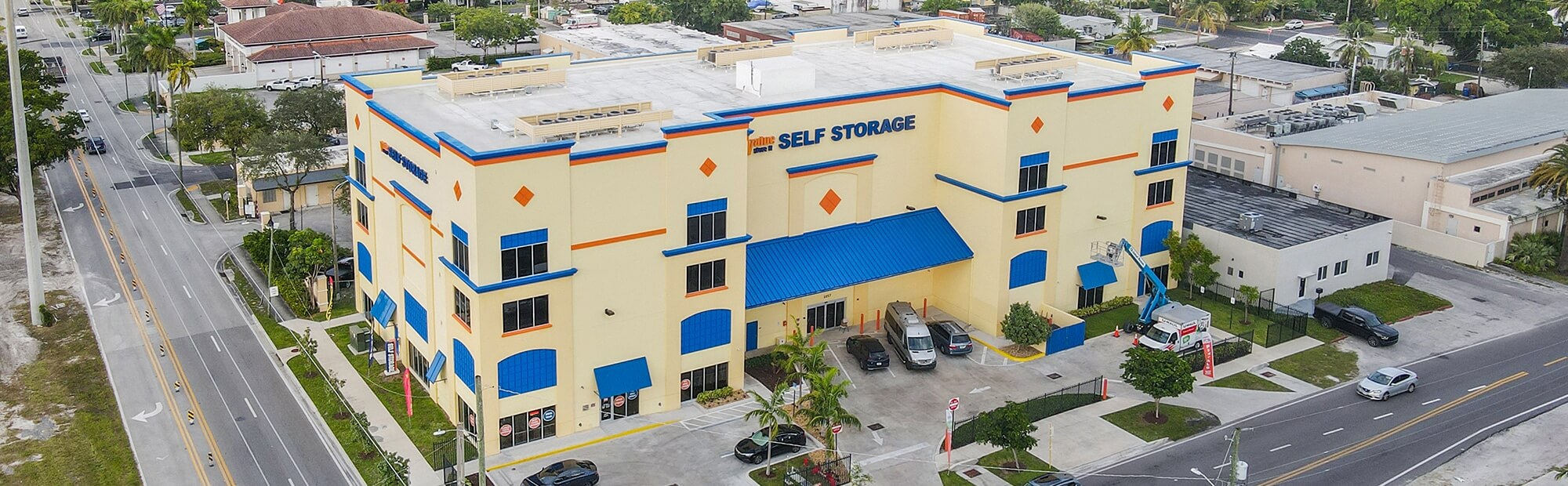
Value Store It rents month-to-month with no long-term contract, which suits a move where the housing plan changes twice before it settles. A 5×5 locker in Miami covers boxes that arrive before your lease starts, and a 5×10 unit in Miami holds the contents of one room. For a whole household, a 10×15 unit in Miami takes a two-bedroom apartment, a 10×20 unit in Miami a three-bedroom home and a 10×30 unit in Miami a four-bedroom home while you hunt for the next place. RV parking in Miami handles the vehicle no Brickell garage will ever fit.
The Miami Airport storage facility is the one to use if you’re landing in Doral, Sweetwater or Airport West. It runs the same lineup, from a 5×5 unit near Miami International Airport and 5×10 storage near the airport through a 10×5 unit near the airport, 10×10 storage near Miami International Airport, 10×15 unit near the airport, 10×20 storage near Miami International Airport and 10×30 unit near Miami International Airport, with climate-controlled units near the airport for anything humidity can damage.
South of the city, the Cutler Bay storage facility serves Pinecrest, Palmetto Bay and Homestead. Sizes start with a 5×5 locker in Cutler Bay, a 5×10 unit in Cutler Bay and a 10×5 unit in Cutler Bay, move through 10×10 storage in Cutler Bay, a 10×15 unit in Cutler Bay and 10×20 storage in Cutler Bay, and top out at a 10×30 unit in Cutler Bay. Climate-controlled units in Cutler Bay handle the humidity, while boat storage in Cutler Bay, RV parking in Cutler Bay and car storage in Cutler Bay cover anything with wheels or a hull.
Miami rewards people who show up curious and let the city sort itself out over a year. Eat your way through the neighborhoods with our brunch guide to Miami, fill the apartment using the Miami shopping guide, and work through the things to do in Miami until the place feels like yours. When the boxes outlast the plan, our Miami location can hold what the new address can’t.